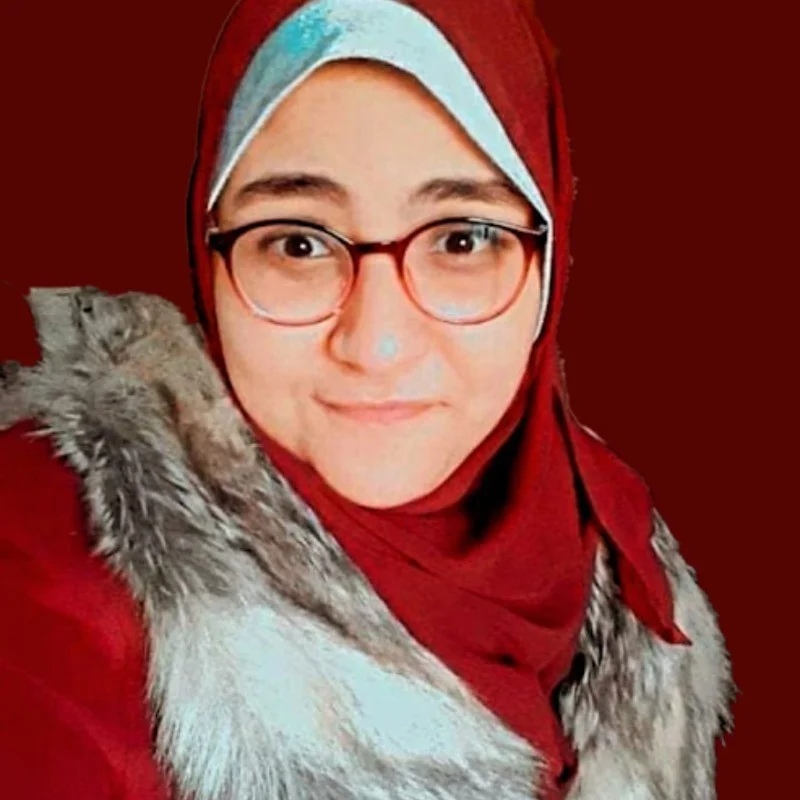
Alaa Salah Afifi
Graduate Scholar
- I am Alaa Salah Afifi, an astrophysicist and planetary researcher , an educator in STEM, and a passionate mentor dedicated to shaping the young minds in science. I hold a Bachelor of Science and education in Physics from Ain Shams University , I'm currently pursuing a Master's degree in Planetary Science at Kepler Space University and have a scholarship offer for a Ph.D. at Strathclyde University.
My journey spans contributions to major global initiatives: I’m a citizen scientist at NASA, a member of NASA’s Cosmic Pathfinders, and a reviewer for NASA’s Roman Space Telescope and Athena X-ray Observatory member. I’ve served as a research intern with the Deep Space Initiative (Andromeda Project) wining team andromeda competition 2024, Resolute Lab India, and Astro Tech Hub. I am also a member of Team WBA, Galaxy Cruise Japanese citizen science project, and the Space Generation Advisory Council (SGAC), where I mentor globally.
As an Ambassador for Open Science, I’ve spoken at global platforms like ISCMP in Paris and Space FUTA Club , and contributed curriculum to the Mars Explorer Program in Canada. I’m a NASA Lifelines Expert Reviewer, a member of Cosmic for Humanity (Switzerland), and was featured as one of Africa’s most influential young women in astronomy in the IAU-AFNWA Storybook.
I've acquired certifications from CERN, NASA PACE, International Space University, EO University, Harvard EdX, and The Open University UK, most of which are in astrophysics, exoplanets, and Earth observation. I was shortlisted in 2025 as one of LinkedIn's Top 100 Women in Science.
My aim is to instill curiosity in students and guide them to create substantial research, scientific thinking, and confidence as they venture into their STEM journey.
- Universities attended -
- Ain Shams University Ain Shams University Bachelor's degree, Physics
- ISDI Parsons : Atlas Skill Tech University - Associate Bachelors in Product Design
- Savannah College of Art & Design - M.A in Creative Business Leadership
- Preferred format of mentorship - 1-on-1 mentoring, Small group research (2–3 students), Short-term Pods (4–6 sessions), Flexible / I’m open to different formats
- Time zone - Cairo Time (UTC +03:00)
- Your general weekly availability for sessions - Monday – Wednesday & Friday: 5:00 PM – 10:00 PM Cairo Time (UTC +03:00) Saturday – Sunday: 2:00 PM – 8:00 PM Cairo Time (UTC +03:00)
- Any additional information you’d like to share with us? -
- Currently residing in the Savannah, US. Might change my location in few months but will keep you informed about anything in advance.
- Brief Summary of Your Research Interests.
- My work has its roots in astrophysics and more specifically in the formation and evolution of supermassive black holes and nuclear star clusters in low-mass galaxies. I study galaxy clusters to determine large-scale structures of the universe and study the evolution and habitability of exoplanets. Planetary science is my interest area, and my areas of interest include cosmic ray shielding, solar power technology for space missions, and planetary habitability. I also contribute to analog space missions and microgravity environments and am working to advance sustainable human presence in space and our understanding of the universe through cross-disciplinary science.
- Please describe your past experience mentoring or teaching students.
- I have mentored and taught students from various international programs and educational programs, attempting to break down complex scientific principles in an interactive and easy-to-understand manner for young minds. As curriculum developer for Canada's Mars Explorer Program, I created educational materials that introduced students to planetary science and mission design. I have also led and conducted sessions and workshops on space radio communication, condensed matter physics, and astrophysics as a conference speaker during conferences such as ISCMP Paris and as an organizer with organizations such as Space FUTA Club I've also been a mentor through global networks such as the Space Generation Advisory Council (SGAC) and Women in Aerospace (WIA) Barcelona, where I mentored junior researchers and students in astronomy and space science, continuously mentoring students in space research studies and citizen science projects. The experiences have taught me the power of stimulating curiosity, reducing complex scientific concepts into easy language, and inspiring students to become confident and ambitious STEM professionals.
- List 3–5 example project ideas students could pursue with your guidance.
- Mapping Stellar Cradles: Star Formation in the Interstellar Medium Project Theme: From real telescope data (, from Spitzer or Hubble), students will calculate sites of star formation currently occurring in nebulae such as the Orion or Eagle Nebula. Skills Gained: Image analysis, understanding gas and dust development, infrared versus optical wavelengths, and spectral signature interpretation. Outcome: Students will construct a visual map of star-forming areas and chart them against existing cataloged clusters of stars.
- Exoplanet Habitability Scorecard Project Focus: Students will choose a set of known exoplanets from NASA's Exoplanet Archive and give each one a habitability index based on temperature, distance from the host star, atmospheric composition, and size.
- Following Black Hole Mergers with Gravitational Wave Data Project Focus: Students will be provided with actual LIGO/Virgo public data sets to examine gravitational wave signals from merging black holes. Students will learn how to interpret strain data and what the data mean about the spin and mass of the black holes. Skills Acquired: Solar system physics, signal processing, data analysis, programming fundamentals (Python/Jupyter notebooks). Product: A timeline of space weather events and a description of how we derive information from solar activity.
- Designing a Solar-Powered Satellite for Space Weather Monitoring Project Emphasis: Students will design a CubeSat or nanosatellite mission to observe solar activity (such as solar flares or coronal mass ejections) with solar-powered instruments. Skills Obtained: Space mission design, solar-terrestrial interaction knowledge, system thinking, energy budgeting. Delivery: Poster or slide presentation with satellite schematics, power system planning, and communication protocols.
- What types of final deliverables can your students expect to produce?
- Research paper
- Literature review
- Data analysis report
- Codebase or technical prototype
- Podcast or video
- Infographic or digital design
- Presentation or oral defense
- Any additional project themes, trending ideas, or real-world challenges you’d love to explore with motivated high school students?
- Bridging the Digital Divide in Education: Exploring access to technology and internet as a barrier to learning in underserved communities—and designing potential solutions. Mental Health and Academic Pressure in High-Achieving Students: Investigating the social and psychological impacts of competitive academic environments and proposing interventions. Sustainable Innovation in Engineering and Design: Examining how engineers can create environmentally responsible solutions to global challenges like waste, energy, or water access. Bias in Algorithms and Tech Design: Analyzing how social biases can become embedded in AI systems and exploring ways to promote fairness and accountability. Culturally Responsive Curriculum Design: Researching how school curricula can be made more inclusive of diverse histories, perspectives, and learning styles.
- 🗣️ Communication & Presentation
- Academic writing (papers, reports)
- Public speaking / oral presentations
- Creating research posters or infographics
- Storytelling through data
- Making a compelling final product (website, video, podcast, app)
- 🔍 Research & Inquiry Skills
- Formulating research questions
- Conducting literature reviews
- Identifying credible sources
- Understanding academic research structures (papers, abstracts, citations)
- Synthesizing information from multiple sources
- 🧠 Critical Thinking & Analysis
- Analyzing arguments and data
- Identifying biases and limitations
- Drawing logical conclusions
- Evaluating conflicting evidence
- 📊 Quantitative & Qualitative Methods
- Designing experiments or surveys
- Statistical analysis
- Data visualization
- Interview techniques and thematic coding (qualitative)
- 🎨 Creativity & Problem-Solving
- Brainstorming innovative solutions
- Connecting interdisciplinary ideas
- Applying knowledge to real-world challenges
- 📅 Project Management & Organization
- Setting research goals and timelines
- Managing independent work
- Documenting progress
- Revising based on feedback
- 🤝 Collaboration & Mentorship
- Working in small research teams
- Engaging in intellectual discussions
- Receiving and applying constructive feedback
- Building research confidence and autonomy